History & Collecting
How Six Unlikely Manufacturers Built Most Second World War BARs
The majority of new M1918A2 Browning Automatic Rifles produced for the United States during the Second World War came from companies better known for silverware, sporting goods and office machinery than firearms. A consortium of six manufacturers, supported by IBM, produced nearly 190,000 BARs for the war effort.
Published 2 October 2026 at 05:11
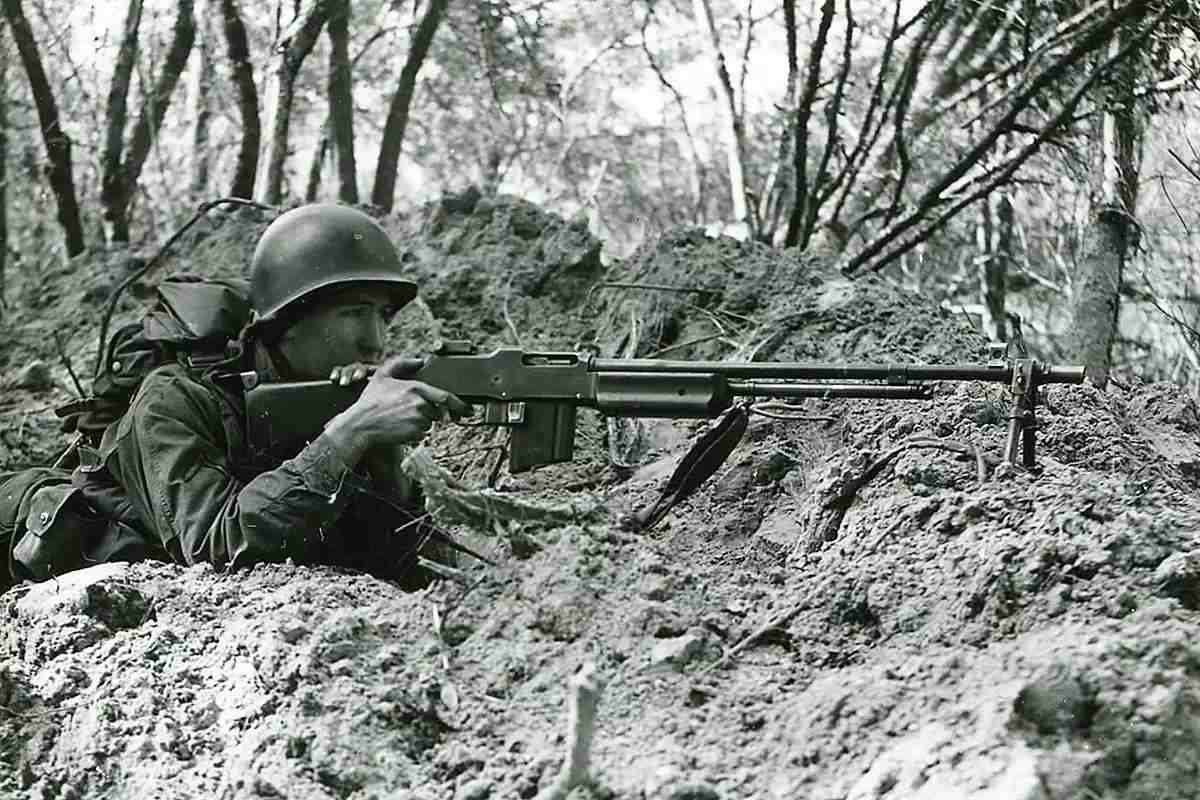
The .30-06 M1918A2 Browning Automatic Rifle is remembered for giving American infantry squads substantial mobile firepower during campaigns in Europe and the Pacific. Less well known is the unusual industrial network that produced most of the BARs issued during the Second World War.
As reported by David Fortier in Firearms News, the overwhelming majority of wartime BARs were not made by established firearms companies such as Colt, Winchester or Marlin-Rockwell. Instead, most were produced by a group of civilian manufacturers with experience in products ranging from silverware and sporting equipment to office machinery and bookbinding equipment.
The original M1918 BAR had been manufactured by Colt, Winchester and Marlin-Rockwell during the First World War. Production then effectively stopped during the interwar period, with the US Army relying largely on existing stocks while funding for new weapons remained limited.
That approach became untenable as the American military expanded from 1940 onwards. Existing BAR inventories could not equip the growing Army, Marine Corps and National Guard, while traditional firearms manufacturers were already committed to other military contracts. Although First World War tooling remained available, much of it had been stored for decades and required extensive refurbishment.
The US Ordnance Department responded by encouraging the creation of the New England Small Arms Corporation, commonly known as NESA, in 1941. The consortium brought together International Silver Company, A.G. Spalding & Brothers, National Blank Book Company, Blake Manufacturing Company, Elliott Addressing Machine Company and Boston Wire Stitcher Company, better known today as Bostitch.
Although these companies had little or no previous experience producing military firearms, they possessed machine tools, factory space, skilled workers and experience with precision manufacturing. Rather than depending on one factory, the NESA arrangement distributed production across several facilities. Individual companies made components that were later assembled into complete rifles.
The changeover presented significant challenges. Stored BAR tooling had to be repaired, modified and in some cases updated for the M1918A2 configuration. Workers had to learn unfamiliar manufacturing processes, while inspectors developed quality-control procedures to ensure that parts made at different facilities would fit and function together.
NESA began delivering M1918A2 rifles to the military by early 1943. The updated BAR had its semi-automatic fire mode removed and included a slower-rate buffer and bipod, making it better suited to its role as a squad automatic weapon. Once production stabilised, the consortium manufactured approximately 168,000 rifles during the war.
IBM also entered BAR production. Although International Business Machines is now associated primarily with computers and information technology, it participated in extensive wartime manufacturing. IBM began delivering BARs in 1943 and produced approximately 20,000 before its contract was terminated as military priorities changed. Its manufacturing resources were subsequently reassigned to other projects, including M1 Carbine production.
Together, NESA and IBM produced nearly 190,000 new BARs during the Second World War. Approximately 90 percent came from the New England Small Arms consortium, meaning that most newly manufactured BARs carried by American troops came from factories that had not previously built firearms.
The wartime production story adds another dimension to the BAR’s history for collectors and students of military firearms. While Colt, Winchester and IBM markings may attract particular attention, the majority of these rifles were products of a six-company industrial partnership that converted civilian manufacturing capacity into large-scale weapons production.
Original sources
- Firearms News Magazine · 31 August 2026 · www.firearmsnews.com