Training & Safety
How to Choose a Safe, Comfortable Holster for Everyday Carry
A suitable holster should protect the trigger, retain the firearm and remain comfortable during normal daily activities. Firearms.co.za’s Moira Kloppers examines the main choices for South African firearm owners, including IWB and OWB designs, materials and fit.
Published 3 October 2026 at 20:58

Choosing a holster is an important part of responsible firearm ownership, not simply a matter of selecting a convenient way to carry. In a guide published by Firearms.co.za, Moira Kloppers says a suitable holster should secure the firearm, protect the trigger, maintain consistent positioning and allow it to be carried safely and comfortably.
The choice can be confusing for South African firearm owners, given the range of products available. Key decisions include whether to use an inside-the-waistband (IWB) or outside-the-waistband (OWB) design, which material is appropriate, and how the holster will work with the owner’s body, clothing, daily routine and intended use.

Safety and fit first
Kloppers advises that the starting point is a holster designed specifically for the firearm being carried. The guide says a properly fitted holster should cover and protect the trigger guard and hold the firearm securely. It also notes that South African firearms legislation requires a handgun carried in public to be carried in a holster or similar holder designed, manufactured or adapted for that purpose, citing SAPS as the source for the requirement.
Retention is another important consideration. The firearm should remain in place during ordinary movement, including walking, sitting down and getting into a vehicle. The guide cautions against choosing a holster solely because it is inexpensive or visually appealing, describing the item as safety equipment whose construction and fit matter.

IWB holsters are worn inside the waistband and are commonly selected for concealed carry because the firearm sits closer to the body. The article identifies Daniel’s Holsters, Highlander Holsters and SouthWest Holsters as South African manufacturers offering IWB options.
OWB holsters are worn outside the waistband. According to the guide, they can provide comfort and easy access, particularly for range use or circumstances where concealment is not the main consideration. Neither configuration is presented as universally superior; the appropriate choice depends on the owner’s needs and circumstances.
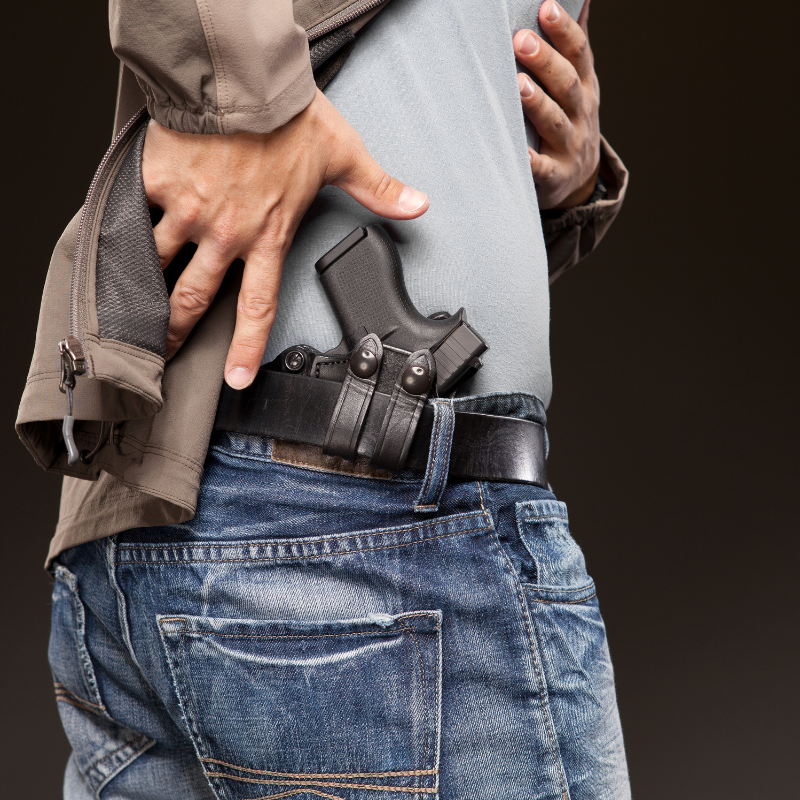
Choosing for the individual wearer
The article argues that holster selection should not be reduced to choosing between a men’s and a women’s product. Body shape, clothing and daily activities vary significantly between individuals. Someone who usually wears jeans and a belt may have different requirements from someone who wears dresses or fitted clothing.
The guide says South African manufacturers offer options for different body types and clothing preferences, including products with adjustable ride height, different attachment systems and left-handed configurations. Its central recommendation is to select a holster for the person who will actually wear it rather than relying solely on gender-based product labels.

Material is another factor, although the guide says it should not outweigh the fundamentals of safe design. Kydex, a rigid thermoplastic that can be moulded to a particular firearm, has become popular for everyday carry. Highlander Holsters, Hindernis, Daniel’s Holsters and Guns & Tactics are named as local producers of Kydex options.
Leather remains a traditional choice, while fabric and other materials are also available. The article stresses that material alone does not determine whether a holster is safe. Fit, trigger protection, retention, construction and suitability for the intended use are more important considerations.

Comfort and daily use
Comfort has a practical safety role because an uncomfortable holster may lead the owner to adjust it repeatedly, remove it during the day or stop using it. Kloppers recommends considering how much time the owner spends sitting or driving, whether the work is outdoors and what clothing is normally worn.
The guide’s advice is that the holster should work with the owner’s lifestyle rather than require major changes to it. Comfort should not take priority over safety, but it can influence whether the equipment is used consistently and correctly.
Before buying, prospective users are encouraged to confirm that the holster is made for their exact firearm, protects the trigger, retains the firearm securely and suits the intended carry method. They should also assess its comfort during normal activities, compatibility with everyday clothing, the security and suitability of its attachment system, and whether they have received proper training in safe firearm handling and carrying.
The guide concludes that there is no universally perfect holster. The appropriate choice is the one that provides the required safety and retention while fitting the firearm, the wearer and the circumstances in which it will be used.
Original sources
- Firearms.co.za · by Moira Kloppers · 4 September 2026 · firearms.co.za